
Free 3D spatial puzzle generator
Count the cubes, draw the views or build the solid. Pick a difficulty, press generate, and print the puzzle plus its answer. No sign-up, no watermark. The same engine behind our KDP Publisher Studio.
How many cubes make up the stack, including the hidden ones?
One dense solid stack.
Customise colours
Clean drops the title band and footer, leaving the figure.
Two pages: the puzzle and its answer. Every figure is checked before it prints, so the answer is never wrong, by the same engine as our KDP studio.
Want the whole book?
This makes one puzzle. Sign up to turn this puzzle type into a full 3D spatial book for Amazon KDP: hundreds of puzzles at any trim, as print-ready PDFs. We carry your puzzle type and difficulty into the studio.
Build the full bookFree to build · pay once to export
Preview
The puzzle and its answer, as they print.
Don't want to build it? Buy the finished book
The same 3D spatial puzzles, graded and formatted as a print-ready PDF. Instant download on Etsy.
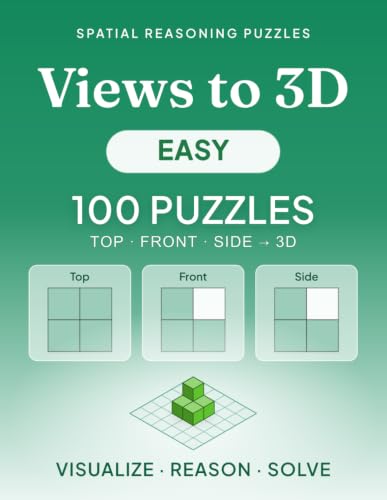
Views to 3D: Easy: 100 Spatial Reasoning Puzzles with Top, Front & Side Views
Printed bookEasy100 easy spatial reasoning puzzles: reconstruct the 3D solid from its top, front and side views.
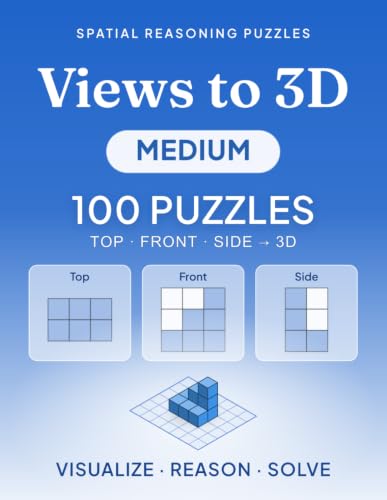
Views to 3D: Medium: 100 Spatial Reasoning Puzzles with Top, Front & Side Views
Printed bookMedium100 medium spatial reasoning puzzles: reconstruct the 3D solid from its top, front and side views.
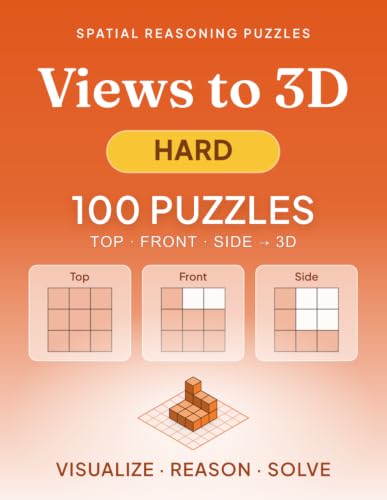
Views to 3D: Hard: 100 Challenging Spatial Reasoning Puzzles with Top, Front & Side Views
Printed bookHard100 challenging spatial reasoning puzzles: reconstruct the 3D solid from its top, front and side views.
How to make a spatial puzzle
- 1Pick a puzzle type and a difficulty. Choose count the cubes, draw the views or build the solid, then a grade from easy to expert. Easy is a 3 by 3 by 3 stack; expert goes up to 12 by 12 by 12.
- 2Generate the puzzle. Press Generate. The engine builds a figure, checks it is connected and supported, and for build-the-solid checks that only one shape fits the views. Then it draws the page.
- 3Print the two pages. Press Print. You get the puzzle on page one and its answer on page two, sized for clean printing at 8.25 by 11 inches or saving as a PDF.
The three puzzle types, and how to solve each
Counting goes from a 3D drawing to a number, draw the views goes from 3D to flat, and build the solid goes from flat back to 3D. Pick a type above and the page redraws. The notes below are the ones the studio prints at the front of a book.
3D to a number
Count the cubes
A stack of unit cubes drawn in 3D on a faint floor grid, and one question: how many cubes make up the figure, including the ones you cannot see?
How to solve it
- 1Count what you can see, from the bottom up. Work one layer at a time. Count the cubes in the base, then the next layer, and so on to the top.
- 2Add the hidden cubes. A cube sitting high up must have cubes underneath holding it up. Those supporting cubes count too, even when you cannot see them.
- 3Check the base is solid. Wherever a tall stack stands, every cube below it is there. Add those in and you have the total.
- The one rule that makes it solvable
- Every cube rests on another, so nothing floats in the air, and the whole figure is one connected piece. That is how you know a hidden cube is really there.
- What the answer page shows
- The answer page repeats the figure with the total printed beneath it.
- How the grades differ
- Easy is a 3 by 3 by 3 stack of 4 to 14 cubes. Medium is 4 by 4 by 4 with up to 26. Hard is 8 by 8 by 8 with up to 130 cubes and at least 40 hidden. Expert is 12 by 12 by 12 with up to 260 cubes and at least 70 hidden.
- Good for
- A first spatial puzzle for children, reasoning-test practice, and adult solvers at the hard and expert grades.
3D to flat
Draw the views
A solid drawn in 3D, with arrows marking the top (T), front (F) and side (S), and three empty grids beside it.
How to solve it
- 1Top view: look straight down. Like a bird above the shape. Shade a square wherever a stack of cubes stands, no matter how tall.
- 2Front and side views: look level. Face the shape head on, then from the side. Shade a square wherever any cube reaches that width and height.
- 3A square is filled if anything is behind it. A view is a shadow on a grid, not a count, so depth does not matter, only whether a cube lines up there.
- Check your work
- Lay your three views beside the solid. Every stack of cubes should cast a shaded square in all three, and no empty column should.
- What the answer page shows
- The answer page shows the same solid with all three grids shaded in.
- How the grades differ
- Difficulty is how many features are cut into or added to the solid, such as notches, steps, tunnels and slopes, not the size of the grid. The figures stay small enough to draw by hand at every grade.
- Good for
- Plan and elevation practice, technical drawing lessons, and the closest match to what spatial reasoning papers ask.
Flat to 3D
Build the solid
Three filled-in views, top, front and side, and a sheet of isometric paper below them to draw on.
How to solve it
- 1The top view is your map. It shows which floor squares hold a stack of cubes. Start by marking those columns.
- 2The front and side views give the height. Each one caps how tall a column may grow along that direction. A column can only be as tall as both views allow, so take the shorter answer.
- 3Build from the floor up, then check. Place cubes so none float. When all three views match your shape, you are done.
- A promise about every puzzle
- Exactly one shape fits all three views with no floating cubes. If you find a shape that matches, it is the answer, and there is no other.
- What the answer page shows
- The answer page draws the solid on the isometric grid.
- How the grades differ
- Difficulty is how many features the solid has, such as notches, steps and tunnels. Slopes are left out of this type on purpose: a sloped face cannot be pinned down from flat views alone, and every puzzle here must have one answer.
- Good for
- Isometric drawing practice, the reverse of plan-and-elevation work, and the hardest of the three for a confident solver.
Want a ready-made puzzle by type, grade or age? Browse the printable spatial puzzles.
Publishing a whole book?
This tool makes one puzzle for home or the classroom. To make a spatial puzzle book you can sell on Amazon KDP, Publisher Studio generates hundreds of graded puzzles of one type, with an optional how-to-solve page at the front, at any KDP trim, as a print-ready 300 DPI interior and answer-key PDF. Generate once, export unlimited sizes.
See the KDP spatial puzzle makerQuestions
- Is this spatial puzzle generator free?
- Yes. Pick a puzzle type and a difficulty, generate a puzzle and print it with its answer, with no sign-up and no watermark. It is free for classroom, home and personal use.
- What kinds of puzzle does it make?
- Three. Count the cubes shows a 3D stack and asks for the total, including hidden cubes. Draw the views shows a solid and asks for its top, front and side view. Build the solid shows the three views and asks you to draw the shape on isometric paper.
- How do I know the answer is right?
- The answer is drawn from the same figure as the puzzle, so it cannot disagree with it. Every figure is checked before it prints: no floating cubes, one connected piece, and for build the solid, exactly one shape that fits all three views.
- Can I sell puzzle books I make with a generator?
- The free tool makes one puzzle at a time for personal and classroom use. To make a book you can sell on Amazon KDP, our Publisher Studio generates hundreds of graded puzzles of one family, at any KDP trim, as a print-ready 300 DPI interior PDF and a matching answer-key PDF.