
The cast and the sets: the art that holds a book together
The Once Books team · 31 August 2026 · 6 min read
Everyone building AI picture books talks about the hero’s face. Keeping the child recognisable across every page is the headline problem, and it’s a real one.
It isn’t the only problem, though. Turn the page and the best friend has a different nose. The teacher’s cardigan has changed colour. The classroom from page three has become a different classroom that also happens to have a whiteboard and a reading rug. None of these is the hero, so none of them gets talked about, and all of them make a book feel wrong on the second read, even when the main character holds perfectly.
Consistency means more than one lock on one face. It’s a locked reference for every character and every place the story returns to. This is what that looks like before we draw a single page.
Why a description alone can’t hold a character
A generative image model has no memory between requests. Every page is an independent guess, and “a curly-haired child in a blue tank top” is a thousand different children. So we don’t re-describe the character each page. We pin them to a reference and draw from it.
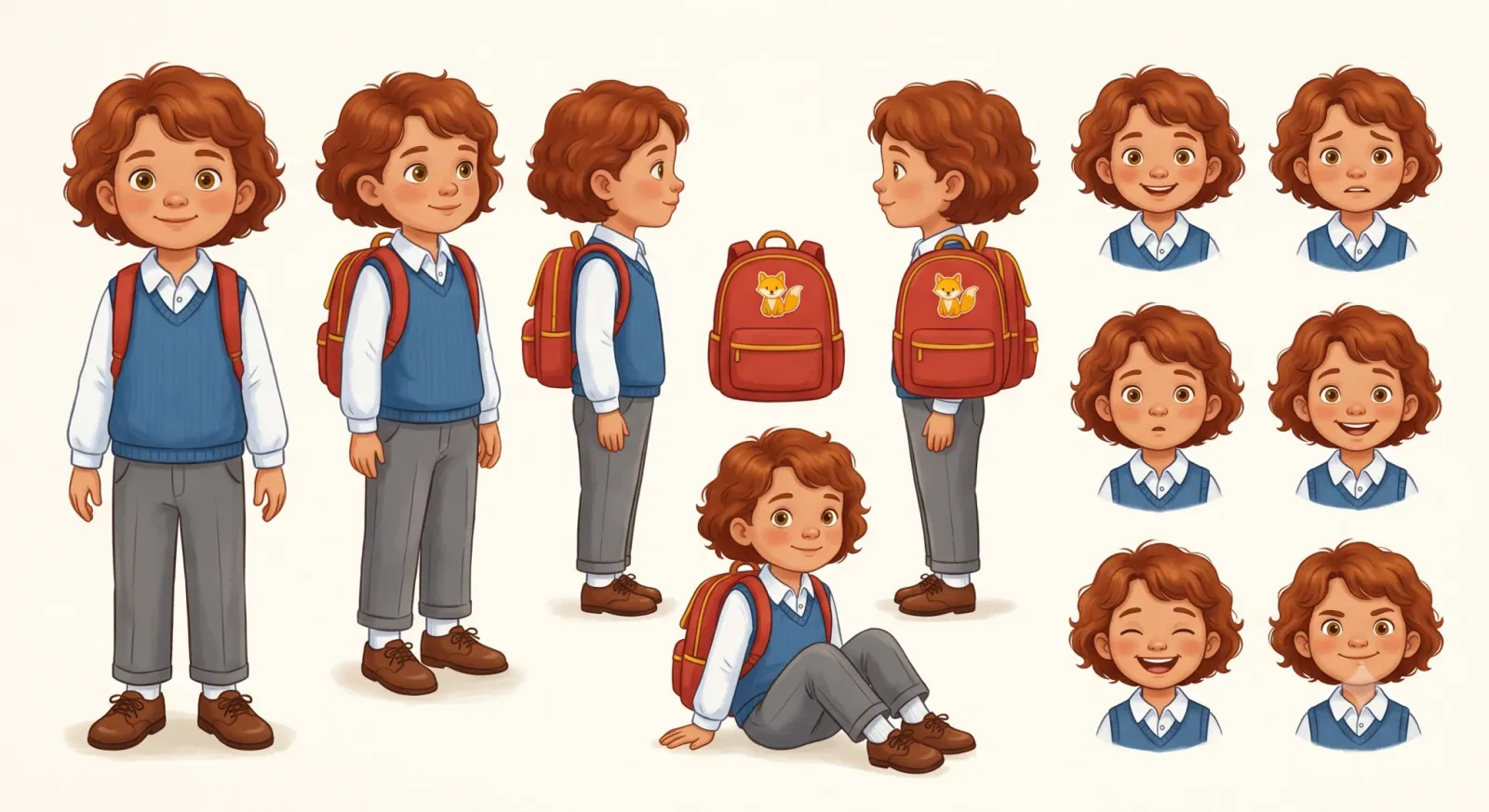
That’s the principle behind the Consistency Engine: the character is locked once, and every later page is conditioned on that locked reference rather than generated from scratch. Change the pose, the expression, the outfit and the setting all you like. The face, hair and skin tone come from the reference, not from the model’s imagination.
The supporting cast is the harder problem
Nobody mentions this part. The hero is the easy character to keep consistent, because the hero gets first claim on everything. The friend and the teacher are harder, and they’re harder for a boring, concrete engineering reason.
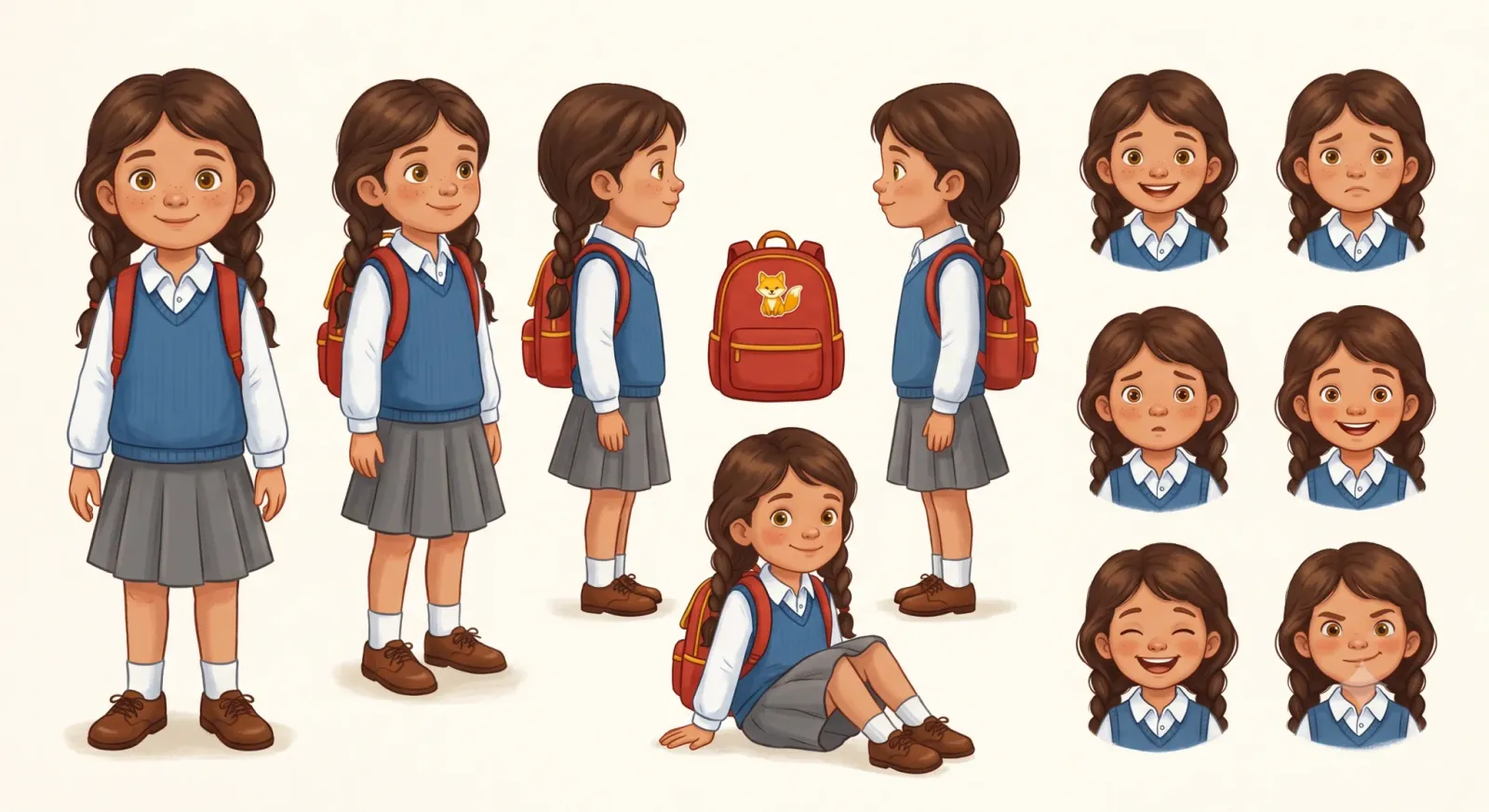
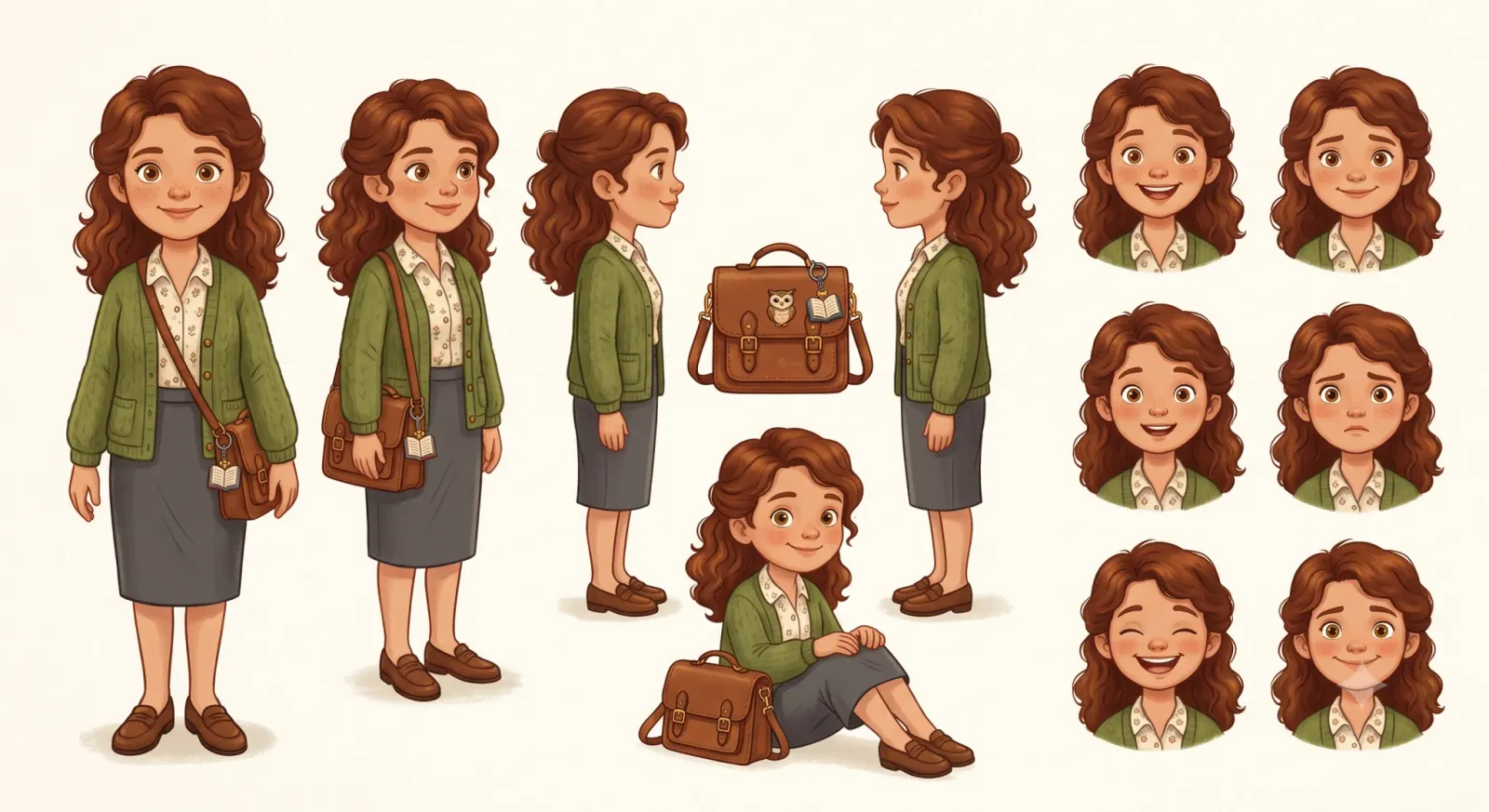
The reason it’s hard: a single generation holds up to 10 reference images, and a crowded page can ask for more. The child and their friend sitting with the teacher leaning in is three faces, three outfits and a room; a party scene is more still. So the engine has to prioritise which references survive into each page. Faces come first, the protagonist before the supporting cast, then the outfits, then the set. The teacher three rows back gets less reference budget than the child in the foreground, deliberately, because a drifting face is most obvious up front.
That trade-off is invisible when it works and glaring when it doesn’t. It’s why a supporting character is slightly more likely to wander than your hero, and why we lock every one of them to a sheet like these, to give the prioritiser the best possible thing to spend its budget on.
The sets get sheets too
A location is a character that never speaks. Without a locked reference, page three’s forest is a different forest by page nine: same trees, wrong forest.
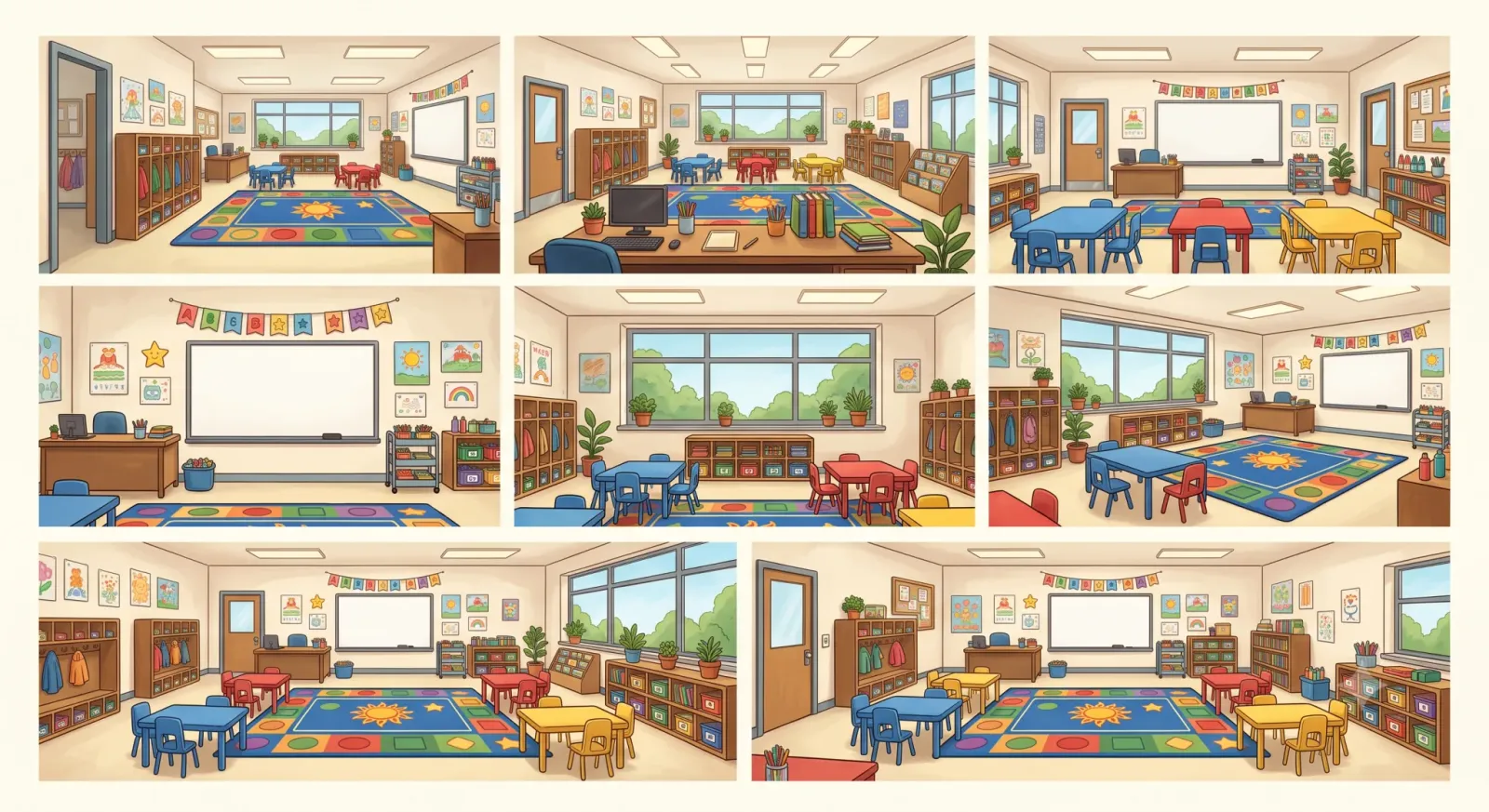
Each recurring place gets a locked description and an establishing shot: a wide, empty view of the set. A scene in the story doesn’t ask for “a classroom”. It points at this classroom. It’s what lets a story move from the school gate to the hallway to the reading nook and back without any of them mutating in the gaps between pages.
What a reference can and can’t do
Two honest limits, because a reference sheet is a tool, not a guarantee.
It doesn’t train a model on your child. There’s no custom model of your kid and no face-matching under the hood. The reference guides each generation; it isn’t a clone. And it doesn’t make every page perfect on the first try, which is why nothing enters your book until you approve it, and any single page can be regenerated on its own without disturbing the rest.
What the reference does buy you is the thing that makes a book read as one book: a hero who is the same child cover to back, a friend who stays the friend, and a classroom that stays put. If you want to see it hold across a finished book, flip through a sample, then start one with your own child and watch the whole cast, and every room, come along for the ride.
Questions parents ask
- Do you draw my child from every angle before making the book?
- We lock your child to a reference, a written Character Sheet plus approved reference images, and every page is generated against it rather than from a description. The point isn’t the number of angles; it’s that the model always draws from the same fixed reference instead of from what it drew a page ago.
- How do you keep the background places consistent, not just the characters?
- Every recurring location gets its own reference too, a locked description and an establishing shot of the empty set. A scene points at that locked place, so the classroom on page three is the same classroom on page nine instead of a new room that happens to have a whiteboard.
- Are the supporting characters as consistent as the main child?
- Nearly. Because a page carries up to 10 reference images, the main child’s face takes priority, so a supporting character is a little more likely to drift. We lock every recurring character and place to its own reference to keep that gap small.
Related reading
The four locks behind a consistent AI picture book
Character consistency across a whole book isn’t a prompt trick. It takes four specific locks, and here’s what each one does and why it matters.
Why AI picture books drift, and how we stop it
Image models are stateless, so page four forgets page three. This is why it happens, and how a locked Character Sheet keeps one child recognisable.
Stripe Checkout without webhooks: a pull-based design
How we confirm Stripe Checkout payments with no webhook: session reuse, a unique checkout key, strict verification and a 10-minute reconciliation sweep.
Keep reading
Answers
One sharply-scoped question per page, cost, safety, timing, printing, answered in a couple of sentences before the detail.
Glossary
Plain definitions of the vocabulary: the Character Sheet, the Consistency Engine, style profiles, drift.
Help centre
Task-shaped instructions for making, printing and sharing a book once you have started one.